Soffit and Fascia: What They Do and the Warning Signs of Rot
Fascia and soffit aren't trim. They hold your gutters, breathe your attic, and seal the roofline against water and pests. Here's what they do and how to spot rot early.
Most people think of the wood along the edge of a roof as trim, something you paint when it looks tired. That's the mistake that turns a $400 board into a $4,000 decking repair. Fascia and soffit are the working edge of your roof, not decoration. Fascia carries the full weight of your gutters and every gallon they hold in a Piedmont downpour. Soffit is the vented underside of the overhang that pulls fresh air into your attic. Together with the overhang (the eave) they seal the roofline against squirrels, birds, wasps, and rain. When they rot, the damage doesn't stay at the edge. It travels into the decking, the attic, and the wall. After 40+ years of roofing across the Augusta area and 3,000+ roofs completed, the pattern we see is always the same: nobody calls about fascia until the gutter is pulling off the house, and by then the wood behind it is gone.
What Is Soffit and Fascia?
Fascia is the vertical board that runs along the edge of your roof, right where the rafters end. Soffit is the horizontal panel tucked under the overhang, the part you see when you stand under the eave and look up. The overhang, or eave, is the section of roof that extends past the wall. These three pieces work as one system, and each one has a job that has nothing to do with looks.
Here's what each part actually does:
- **Fascia:** the mounting board for your gutters. Every gutter spike, hanger, and bracket fastens into the fascia, so it carries the weight of the gutter plus the water and debris load. It also caps the ends of the rafters and blocks the roofline from wind and rain.
- **Soffit:** the ventilated intake for your attic. Vented soffit lets cool air pull in low at the eaves so hot attic air can push out high at the ridge. It also closes off the underside of the overhang so pests can't nest in the rafter bays.
- **Overhang (eave):** the part of the roof that projects past the wall, throwing rainwater away from your siding and foundation and shading the wall from direct sun.
Signs of a Rotted Fascia Board
A rotted fascia board rarely announces itself. It shows up in the things it's attached to first, so the earliest warning is usually a gutter problem, not a wood problem. Look for these signs, roughly in the order they appear on the homes we inspect around Richmond and Columbia County:
- **Gutters pulling away or sagging.** When fascia softens, the gutter fasteners lose their grip. A gutter that's tilting, separating at a seam, or sitting lower on one end almost always means the wood behind it has gone soft.
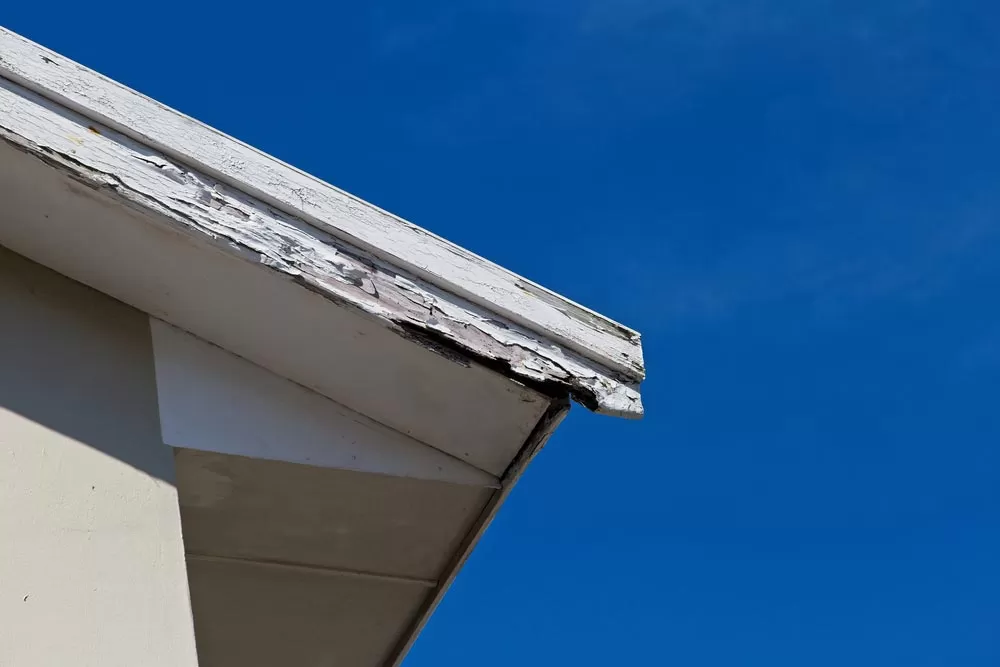
- **Peeling or bubbling paint on the fascia.** Paint blisters when moisture is trapped behind it. That's water already in the board, not a paint-quality problem.
- **Dark staining or streaks running down the fascia and siding.** Overflowing or leaking gutters leave a tell-tale drip line. Where that water sits, rot follows.
- **Visible soft spots, cracks, or wood you can push a screwdriver into.** Healthy fascia is firm. If a probe sinks in or the board flexes, the rot is advanced.
- **Animals in the eaves.** Squirrels, birds, and wasps get in through a gap where fascia or soffit has failed. Scratching or nesting sounds near the roofline are a structural warning, not just a nuisance.
- **A soffit panel that's stained, sagging, or crumbling.** Soffit rots from water that got past the fascia or from attic moisture with nowhere to go. A drooping soffit means moisture is already inside the overhang.
If you're seeing two or three of these together, the damage has usually spread past the visible board. A free roof and roofline inspection is the fastest way to find out how far it's gone before you pay to rehang a gutter on wood that won't hold it.
Why Is My Fascia Rotting? The East Georgia Reasons
Fascia rots because it stays wet, and the humid-subtropical Piedmont gives it plenty of chances. Three local drivers do most of the damage on the roofs we see across Augusta, Martinez, and Evans, and they stack on top of each other.
First is water that never drains. Our dense spring pollen loads gutters solid every year, and once a gutter clogs, water backs up over the lip and runs straight down the face of the fascia instead of through the downspout. That constant wetting is the number one fascia killer in this market. Add the summer humidity that keeps everything from drying out, and the board never gets a chance to recover.
"Nine times out of ten, a rotted fascia in this area started as a clogged gutter that nobody flushed after pollen season. The wood is the symptom. The water is the cause."
Second is our heavy oak and pine cover. Limbs that scrub the roofline in every storm knock loose the paint and caulk that seal the fascia, opening seams for water to creep behind the board. The same tree canopy drops leaves and needles that pack into the gutters and hold moisture against the fascia for weeks.
Third is age and the older housing stock. Early-1900s Summerville bungalows and mid-century ranches often have original wood fascia that has been painted over so many times the wood underneath can't breathe. On those homes we frequently find the rot is decades in the making, hidden under a fresh coat of paint that looks fine from the street. That's why we wrap replacement fascia in aluminum after we prep it, so the new wood is sealed against the next 40 years of Georgia weather.
Does Soffit Ventilation Matter in a Hot, Humid Climate?
It matters more here than almost anywhere. Soffit is the intake half of your attic's breathing system, and in a long, hot, humid summer that intake is what keeps your attic from turning into an oven that bakes your shingles from below and drives up your cooling bill. Cool air enters low through vented soffit, rises as it heats, and exhausts high at the ridge. Block the soffit and the whole system stalls.
The most common failure we find on East Georgia homes is a solid or painted-over soffit with a ridge vent up top that has nothing to pull against. The attic traps heat and moisture, the decking sweats, and that trapped moisture is exactly what rots soffit and fascia from the inside out. So ventilation and rot aren't two separate problems. A blocked soffit causes the moisture that destroys the wood, and rotted wood then breaks the ventilation. Fixing one without the other is why some repairs don't last.
Because vented soffit, fascia, and the overhang all move together, we treat them as one job. Our fascia, soffit, and overhang repair work opens the intake side back up and addresses any rot or water damage in the same visit, with a paint-matched or aluminum-wrapped finish so it holds.
When You Should NOT Rush to Replace Fascia
We'll tell you when to wait, because we'd rather keep you as a customer than sell you a repair you don't need yet. If your gutters are draining cleanly, your paint is intact, the fascia is firm when pressed, and you're only seeing a little cosmetic fading, you probably don't need fascia work right now. Faded paint on sound wood is a paint job, not a replacement. What actually changes the answer is water: a clogged or overflowing gutter, a soft spot, a stain line, or animals in the eave. Clean the gutters first, especially after pollen season, and see whether the "fascia problem" was really a drainage problem. If it dries out and stays firm, leave it alone and put your money elsewhere. A free inspection will tell you which camp you're in before you spend a dollar.
Fascia, Gutters, and the Right Order of Work
This is the sequencing question that saves homeowners the most money, so we'll be direct about it. If your fascia is rotted, you fix the fascia before you rehang or replace gutters, not after. Hanging a new gutter on soft wood is hanging it on nothing. The fasteners won't hold, the gutter sags again within a season, and you've paid twice. The right order is: replace the rotted fascia, seal and finish it, then mount seamless aluminum gutters and gutter guards into solid wood that will actually hold the load. If your gutters are the only real problem and the fascia is sound, gutter repair on its own is a legitimate fix, and we'll say so. The point is matching the work to the actual condition, not upselling a roofline you don't need.
The Bottom Line
Fascia and soffit are the working edge of your roof, and in East Georgia's humid Piedmont climate they take a beating from clogged pollen-loaded gutters, limb scrub, and trapped attic moisture. Catch the warning signs early, a sagging gutter, peeling paint, a stain line, animals in the eave, and you're looking at a board or two. Ignore them and you're looking at decking and wall repair. Davis Construction & Roofing Co is licensed in Georgia and South Carolina, family-owned, and backed by 40+ years of roofing experience and 3,000+ roofs completed. Real humans answer the phone, no call centers and no script. Call us at [762-477-3858](tel:+17624773858) for a free roofline inspection and a straight answer on whether your fascia needs work or just a gutter cleaning. Honest pricing, zero surprises.
How This Applies to Your East Georgia Roof
Every Augusta-area roof we touch starts with a free on-site inspection. We climb the deck, photograph what we find, walk the attic for ventilation and decking notes, and send a written estimate within 48 hours of the visit. If the article above raised a question about your specific roof — age, pitch, decking, ventilation, or insurance status — the inspection is where we answer it with photos and measurements instead of guesses.
We work the full CSRA and East Georgia footprint: Augusta, Martinez, Evans, North Augusta, Grovetown, and Savannah. Crews are factory-trained on the systems we install, fully insured for workers' compensation and general liability, and licensed in both Georgia and South Carolina. Manufacturer warranties stay valid because we install to spec — and our written workmanship warranty stands behind the install for the life of your ownership.
If you are dealing with active storm damage, do not wait for the article to finish — call us. We answer 24/7 and can have heavy-duty 6-mil reinforced poly tarping installed within a few hours of the call so the next squall does not make the inside of your house worse.